Bean Boy
In August, the 4-year anniversary of my adopting a mostly plant-based diet passed without my noticing. I only thought of it, because, over the holidays, during a family dinner, someone asked “are you still doing that?” Oh yeah. Turns out I still am.
What does mostly plant-based mean?
I eat some fish, some dairy and eggs, but no beef, chicken, pork, etc. You could say “ovo-lacto-pescatarian” but jeez.
Basically it’s approaching food with a focus on personal health and harm reduction. The goal isn’t perfection. If I am traveling, I go with the flow. If friends or family attempt to feed me, I eat what I am served. I am not on a mission to convert anyone. I am just trying to do better for myself. Thankfully, my wife has enthusiastically joined me on this journey. I don’t have to cook dinner twice.
Why though?
A little while before I decided to change my diet my wife and I were hanging out with an old friend. My wife and the friend are both doctors. If you’re drinking wine with doctors, sooner or later someone is going to break out a blood pressure cuff and a stethoscope. Our friend, the marathon runner, checked her blood pressure and it was - let’s say - athletic. Then we all checked our blood pressure. My wife’s was normal. Mine was alarming.
I visited my doctor and got a prescription for a medication. It helped, but not much. We added a second medication. A little better, but not much. I realized that soon I’d be taking a fistful of pills every morning. So I made a change.
But this is only part of the story. This was my camel-back-breaking-straw. For years I have had an intrusive thought buzzing around my head: For an American, with a good job, living with abundance, there is no excuse for killing animals for food. It’s not necessary, it hasn’t been necessary for a very long time. It is not justifiable.
Before you start drafting up a rebuttal with which to lecture me: Yes, I know there are many other horrible things in the world. This is a small thing, I get it. But small good things are still good things. Small good things lead to bigger good things. I also return my shopping carts to the corral.
What do you eat?
Early last year, I caught up with some cousins outside of Memphis, TN. My wife and I were trying to explain ourselves. They were asking us, in good faith, and out of curiosity: What do you eat?
It was actually a very good question, and it seemed hard to answer in the moment. The short answer is “beans”.
Most Sundays I’ll make a big batch of pintos or black beans just to have around. I’ll sometimes make refried beans. Other times I’ll add tomatoes and onions. To black beans I might add frozen corn. If I’m feeling fancy I might roast the corn on a sheet pan. The beans go with rice or tortillas for a meal or an egg on top for breakfast.
I make a hearty ragu from red lentils tomatoes and onions which is great on rigatoni. I occasionally buy fancy lima beans from Rancho Gordo and make a quick pan sauce from the beans and their cooking liquid, butter (or plant based butter), and toss this with fettuccine.
But generally the answer is “beans”. It’s beans.
Bowls over plates
Changing my diet meant changing my expectations.
The classic American dinner plate with a slab of animal protein, a starch, and one or two vegetables doesn’t translate well to a vegetarian diet. A block of tofu doesn’t anchor a plate like a roasted chicken breast does. This plate will feel empty. Fake meat products are generally pretty awful (and loaded with salt). Vegetarian meals need to be more holistic and integrated. So bowls, not plates.
I go for bowls of rice or grain (quinoa, barley, faro) with legumes or tofu. I go for curries which are spicy, hearty, and rich. Hummus smothered with spicy roasted vegetables (broccoli, cauliflower, etc) and drizzled with olive oil sits in between a snack and a meal. Perfect for lunch. Nothing in the bowl feels like a substitute.
Fancy toast
I have baked my own bread for a long time. Recently I’ve been trying to get better at focaccia. Good bread begets excellent toast. The millennial favorite avocado toast is great. It pairs well with a fried egg if you want. I also like to do a spin on a Mexican dish molletes, which is refried beans on good toast with onions and perhaps cotija cheese. In Mexico this is typically a breakfast dish, served alongside eggs and coffee.
A toasted or grilled slab of bread smothered in ricotta cheese and topped with pistachios is one of my favorites. When I’m feeling more virtuous, I’ll blend medium-firm tofu up with salt, lemon juice and zest, nutritional yeast, and olive oil to make a rich spread. Either of these topped with toasted nuts and balsamic vinegar is a treat.
Curries
Indian cuisine is really complex and difficult to master, but it’s not too hard to create a very tasty (if not authentic) dhal with lentils, split peas, or chick peas. Chana (chick pea) masala is pretty easy to fake as well.
I never have all the right spices around but I get by with whole and ground cumin, turmeric, coriander, cinnamon, and nutmeg. I will substitute paprika for chili powder for flavor and color when I’m cooking for us both. My wife suffers from a serious condition known as “baby mouth” and cannot handle even mild chilis. I keep a pre-made garam masala around as well. I’m missing fenugreek some other whole spices, and probably an army of peppers too.
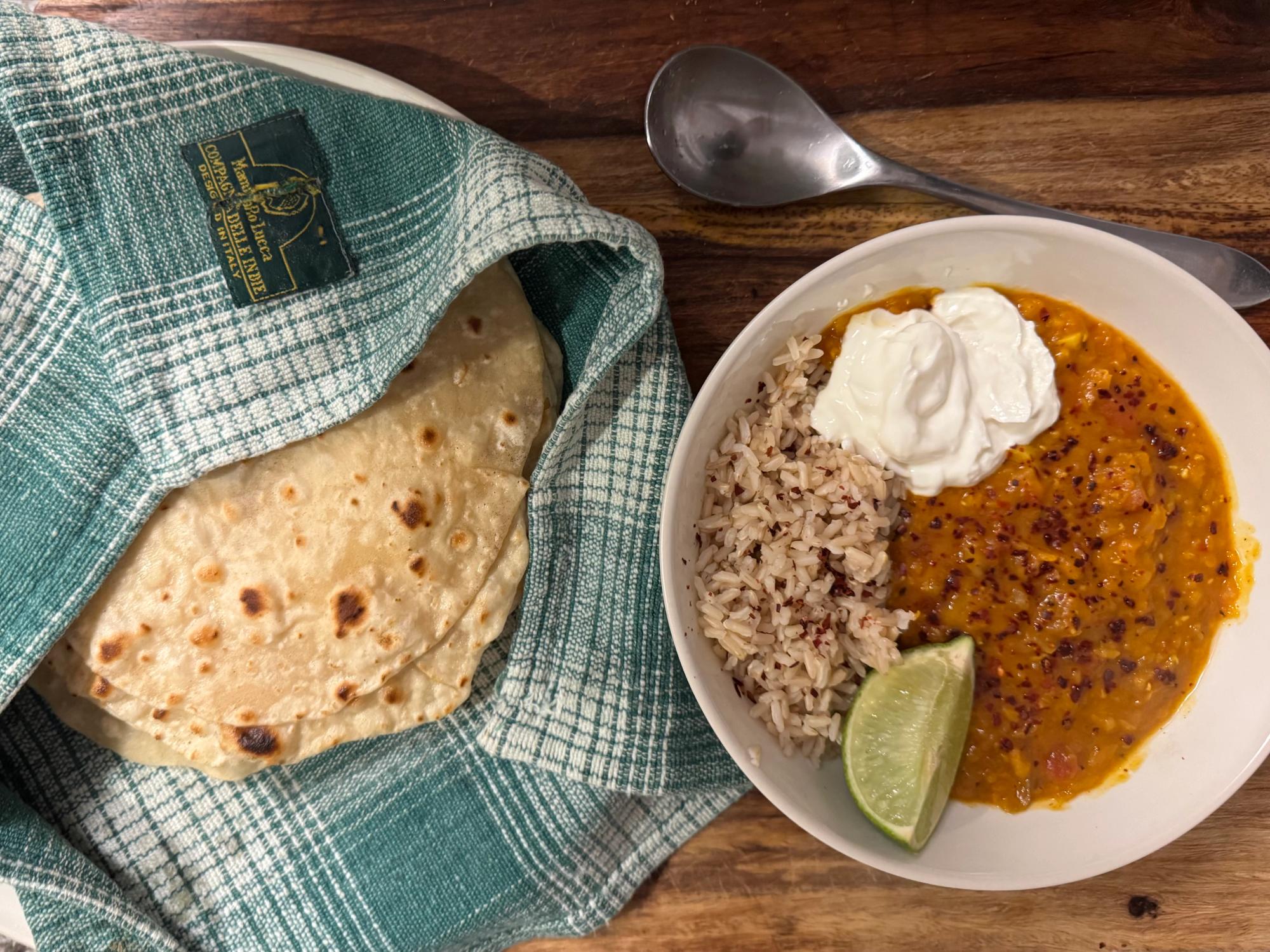
But it tastes great, makes the house smell wonderful, and topped with a drizzle of yogurt and fresh cilantro and a squeeze of lime juice, it’s a great dinner and leftovers are great for lunch the next day.
When I have time, I’ll make roti, Indian flatbread. Roti is very simple, just flour, a pinch of salt, and enough water to make a dough. I mix about a cup of flour with 5-6 ounces of water. I mix this together in a bowl until it forms a ball, and knead it just a few times. I divide the dough into 8 golf-ball sized pieces, flatten these into disks, dunk them in flour to prevent sticking, and then roll them out to 8-inch rounds. Each round is cooked in a dry skillet until brown spots appear. Then I place the roti over an open flame on my stovetop until they puff up. Brush with melted butter or olive oil and stack in a plate, wrapped in a towel. Leftover roti at breakfast makes a good wrapper for a scrambled egg.
Complex rice
In wintertime I like to make a risotto and pair it with a small salmon fillet. I use vegetable stock and white wine instead of chicken or beef stock. I start with onions, carrots, and celery diced and cooked in olive oil until soft before adding the rice, wine, and slowly ladling in stock.
Paella is another cold-weather go-to. I like to add red bell peppers and green beans for color and texture.
I also like to make onigiri, Japanese rice balls, and fill them with steamed soybeans or a slab of salted tofu or whatever. They’re great for lunch or a quick snack. I bought a small set of molds to make it easy. I steam short grain rice, season with a little rice vinegar and mirin, and let it cool a bit. Add a little rice to a mold, add some filling, press the top onto the mold, then pop out your perfect little rice triangle. Wrap in nori and dip in furikake.
Frozen veg
I think there’s a trend of people realizing that frozen vegetables are really pretty good, actually. They’re not going to be great in a salad of course, but work fine coated in olive oil, seasoned, and roasted on a sheet pan. Frozen green beans can go right into a hot wok and be stir-fried quickly. Frozen peas can quickly top pasta or be stirred into the rice for onigiri. The heat from the rice will thaw the peas and give your onigiri a nice little pop of color and some protein.
One of my favorites is frozen pearl onions. I toss these with salt and olive oil and roast them on a sheet pan for about an hour so they caramelize. They are delicious on top of an omelet or a bowl of hummus.
Don’t you miss bacon?
I don’t really miss any meat. On the rare social occasions where I have a little beef or chicken, it’s only just fine. It’s not amazing. I don’t suddenly find myself craving fried chicken. I never want a burger.
I do miss some rituals of cooking. I used to roast a whole chicken on Sundays. I really enjoyed the art of carving up or spatchcocking a bird for the oven. I liked making stock from the carcass and using that stock to make risotto or adding to veggies later in the week. This made me feel like a chef.
I miss convenience. If I’m traveling and looking for fast food in an airport, there’s often only a sad egg-salad sandwich or an anemic caprese sandwich in the cold case. It was nice to be able to grab basically anything without thinking too much about it.
Does it work?
Well don’t I seem smug and self satisfied?
The best “results” I can claim is that my hypertension is stable and well managed with minimal meds. My weight is stable (this is a happy accident). And now, I can cook lots of different things.
Before I changed my diet, I spent a lot of time trying to wade through complicated decisions, trying to do the best thing. Is grass fed better than organic? The same? Is pasture-raised the same as cage free? Are either of these organic? There’s a small universe of decisions and considerations I don’t have to think about. I never worry about the provenance of a lentil.
So healthier, happier, simpler, smug. It works for me.
Subscribe
New work and writing, straight to your inbox.