New work: The crows return to Venice in autumn
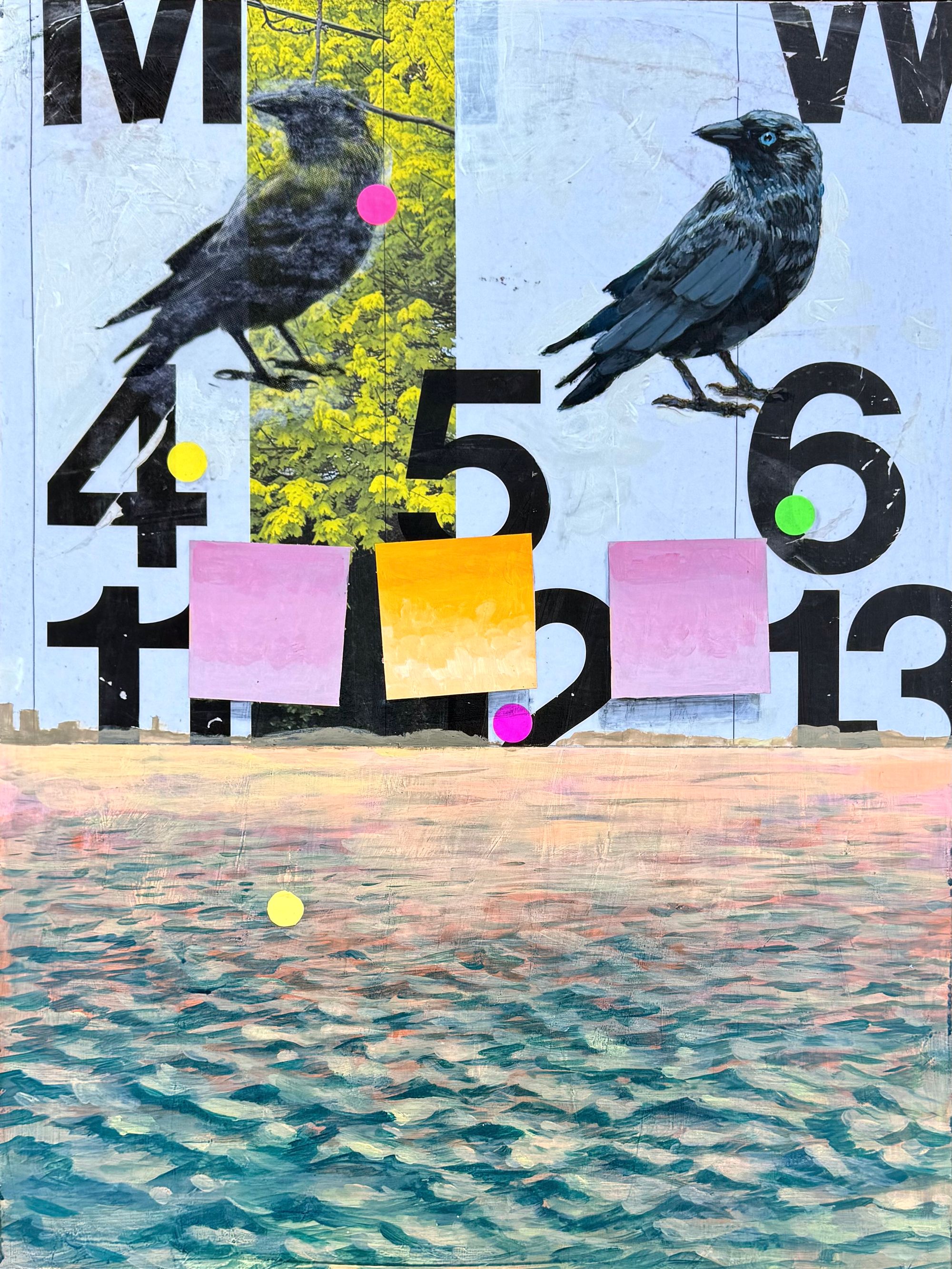
This painting began with two failed experiments.
I have a giant roll of sheets from my very large Stendig wall calendar (4ʹ × 3ʹ). One sheet for each month. The Stendig Calendar is typeset in Helvetica Bold with tight kerning. A tiny hairline divides the days into columns.
First experiment: Wouldn't it be cool to print a photo on one of these sheets so that the calendar shows through the image? I carefully cut a calendar sheet down into two 18ʺ × 24ʺ sheets. I chose a snapshot of a vibrant green tree in my neighborhood. The canopy of the tree is bright yellow-green and casts a shadow over the trunk, creating a sort of cave beneath. I carefully loaded the first sheet into my printer, twiddled the digital knobs, and when the paper emerged, the photo was cropped to a thin strip on the left side of the page.
I tried again. Same result. I realized the printer was "seeing" the black letters M, T, and W at the top of the page. The jet-black convinced the printer that there was no paper there and it should only print between Monday and Tuesday.
Second experiment: Wouldn't it nice to use these (failed) prints as a backdrop for a painting? Like I do with my printed canvases? I tried laminating the sheet of paper to a painter’s panel using the same archival book binding glue I use on big heavy canvas. I used too much. The paper became saturated and buckled.
Once it dried the surface was wrinkled and lumpy. I sanded it smooth with my orbital sander. This left the surface distressed and broken, as if my calendar was very very old.
It all worked out fine.
Visual inventory
What are we looking at here? From top to bottom, there is first the calendar backdrop with the thin strip of tree printed over some of the letters and numbers. Next there are two crows. One on the left is an photo-image transferred to the surface using science and the other is a hand-painted rendition of the same bird. Twins?
Sticker-dots mark off days on the calendar. They infiltrate the crow on the left.
Next are three trompe l’oeil sticky notes: pink, yellow, pink. Below the notes is a vast stretch of water, reflecting pink and yellow from an unseen sky. In the distance is a bit of skyline.
One more sticker-dot floats in the ocean.
Eakins digression
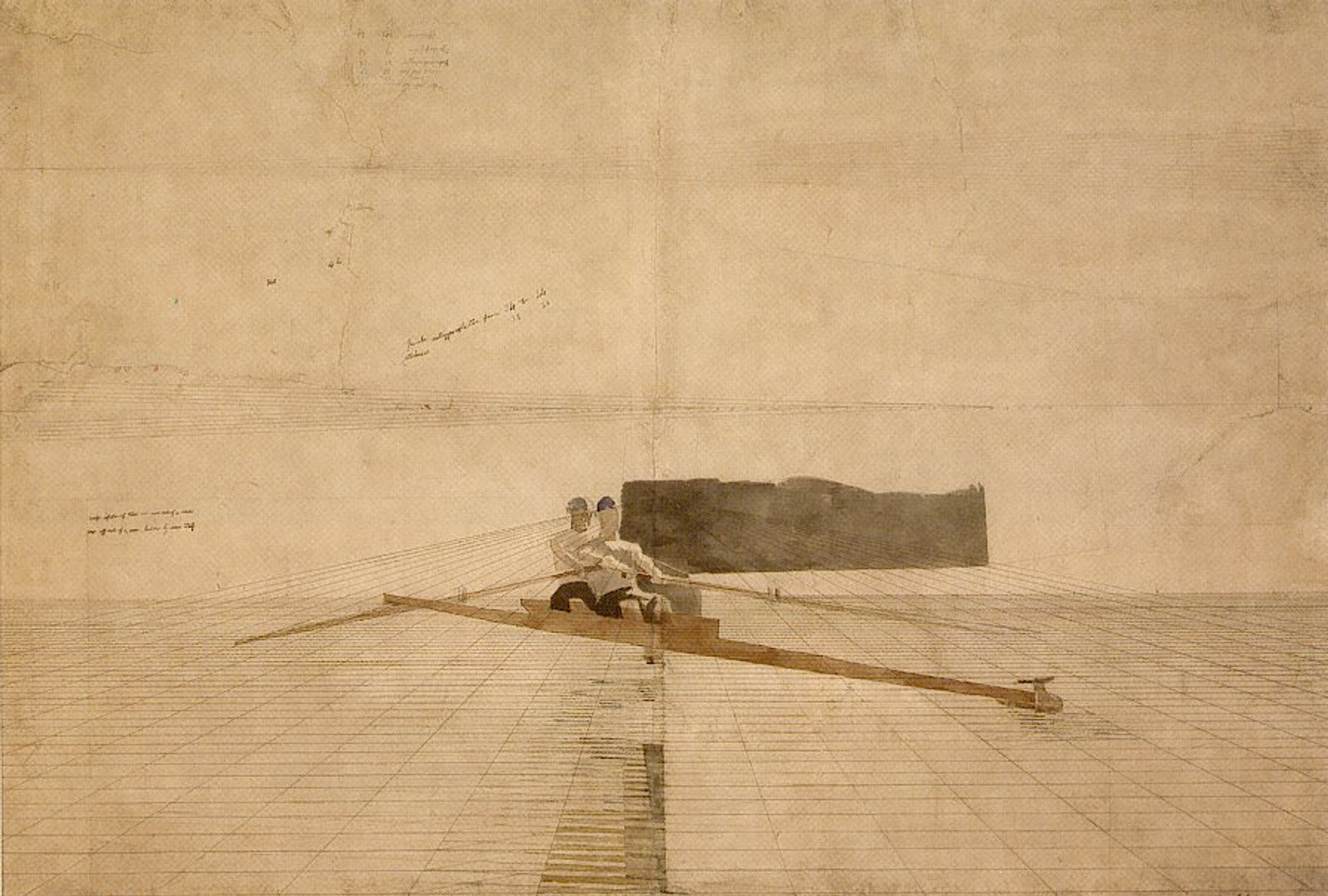
Drawing of the Pair Oared Shell by Thomas Eakins
I think I might have been in Junior High or maybe High School when I saw this image. It must have been a reproduction in a book, but in my hazy memory I’m looking at this framed on a wall. That seems unlikely, but maybe the Mint Museum of Charlotte really did have an Eakins study on the wall.
What you see here is a study for one of Eakins’ famous paintings of rowers. Eakins has laid out a 1-point perspective grid to represent the surface of the water. What I remember tickling my brain was that Eakins was creating a system to paint ripples and reflections in water. Here he has divided each perspective grid square up with diagonals and assigned each section a part of the reflection. Once painted, the effect is completely lifelike, as if the water held still long enough for him to paint it.
This is a magic trick. He used predictable, orderly grids to depict something fluid and chaotic. I remember feeling like someone peeled back the top layer of the universe so I could peek underneath.
Painting water
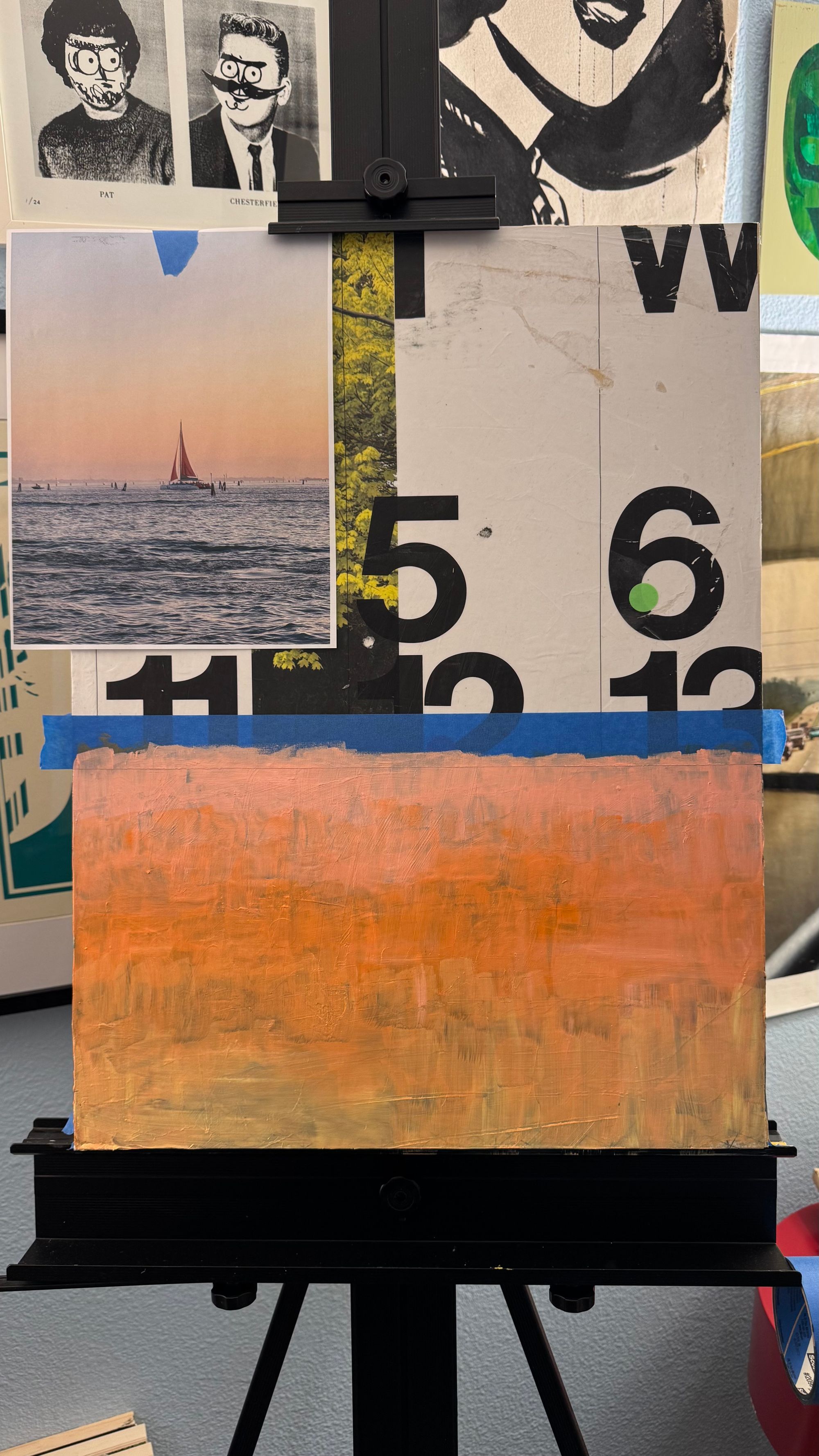
The reference for my lagoon was a snapshot photo I took from a vaporetto (water taxi) in Venice just about a year ago. We were chugging along into the mouth of the Grand Canal. The sun was going down.
To try to capture the surface of the water, I ripped off Eakins and created a 2-point perspective grid using a 48ʺ ruler, an 18ʺ ruler, blue painter’s tape, and some books to level everything out. A classic 2-point perspective drawing exercise renders a cube turned so that one corner is turned out to the viewer. The resulting grid is little diamonds instead of trapezoids. Imagine standing on a giant checkerboard and turning 45º to look to the corner of the board.
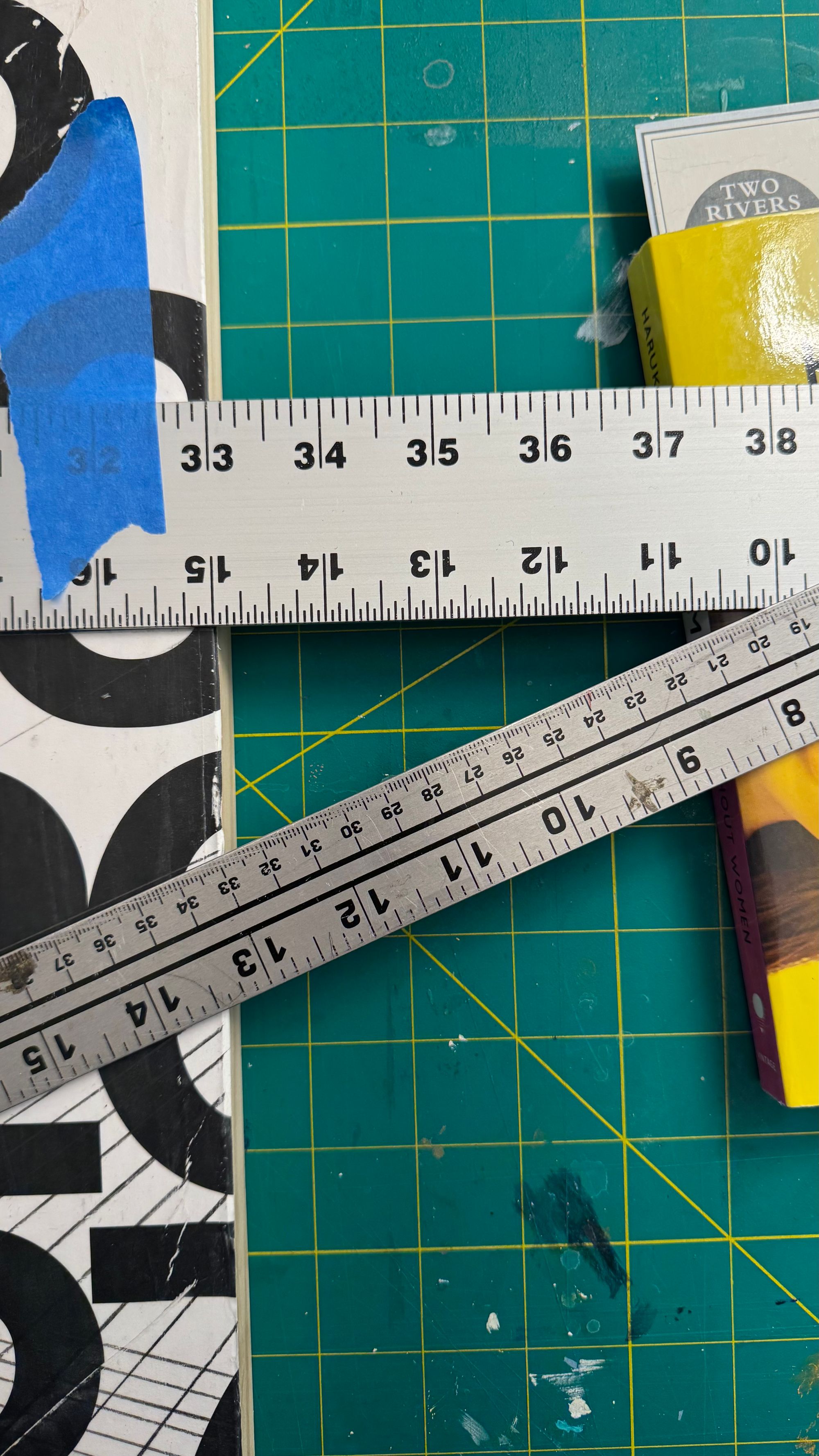
I painted a rough gradient of sunset colors over the grid. The lines were faint, but visible. I painted the shadowy side of waves in dark blue using the intersection of grid lines as a guide. I added highlights and then glazed the surface in unifying colors until everything felt cohesive.
Stickies
Above the ocean I’ve placed three stickies in pink, yellow, and pink. I feel like these are classic pastel sticky note colors, but they also directly reference the colors “reflected” in the water below. Here they are functioning as a stand-in for a sunset sky.
On my first attempt, I painted three pink stickies all the way across and tried to add a hand-drawn happy sun in the middle. It was a little bit on-the-nose, but more importantly it just looked like shit. So I taped it off, pained over it with white gesso, and repainted as a sunny yellow. The color is the metaphor; no need for a graphic.
The stickies are actual size at approximately 3 inches square. They are a tiny bit curled, so they’re not perfect squares. The size, color, and the tricky shadow should fool the eye at first glance.
Birds
It’s crow season in Portland. They are everywhere. They show up in Autumn and roost here for the winter. Great flocks of them show up and take over city blocks. It is ominous and no one seems to care. It looks like the end of the world.
By winter time the crows are roosting and adolescent crows start hanging out on power lines and yelling at passers by. Crows are beautiful, smart, and creepy. Like a squadron of mean goth girls who get your attention just to make fun of your shoes. I shoot many pictures of crows lurking on power lines.
On the left, is a stock photo of a crow, which I set to black and white and applied a half-tone filter (like you see in printed newspapers). I transferred the image to the surface by embedding the printed image into acrylic medium and then removing the paper. I followed the technique I found in this charming little YouTube video which works by applying a thin layer of liquid acrylic medium to your work surface, applying your ink-jet print ink-side-down, waiting 5 minutes, and pulling off the paper. Most of the paper is removed this way. Any bulky blobs of paper fiber can be rubbed away, and the rest is rendered transparent through the application of acrylic varnish. It’s a pretty neat trick.
On the right I hand painted the self-same bird. I created a rough outline of the bird by using graphite transfer paper, ensuring my birds are the same size. Then I carefully painted my crow friend with bright blue eyes and shiny feathers.
Dots
The dot-stickers on the painting are real, in that they are real stickers I really stick on my real calendar to mark the days. I added a dot sticker over the left crow to integrate it into the background of the painting.
But that’s a lie. One of the stickers is paint. I carefully cut a ¾ʺ circle out of painter’s tape, matched the color of another sticker with paint, and created a sneaky replica.
That’s one interpretation
When I work on a painting I try to not to plan and execute, but instead try to explore and discover. I’m leaning hard on happy accidents and reacting creatively to the last thing I did. In my day job, as a Director of Technology, I am beholden to plans, schemes, schedules, deadlines, and agendas. So when I’m working on a painting I want to let my mind wander and see what happens. I suppose if art was my day job I might be more architectural in my approach.
This painting began with a failed printer experiment and became a meditation on time. After my printing blunder, the panel sat under my desk for at least a year before I discovered what I wanted to paint on it (and found the time to do it). The calendar back-drop is on-the-nose symbolism for marking the passing of time as it’s a literal artifact of that activity. The water is inspired by a memory and another memory; remembering a moment in Venice brought to life by remembering an Eakins drawing.
The repetition of elements imply time passing. The two crows (or the same crow twice?) are like frames from a film. Sticky notes are used by product and engineering teams for planning and roadmapping exercises. Sticky notes with ideas scrawled on them in black marker cover conference room walls like confetti after a clown explosion. “This is our 14 month roadmap” a product manager will say, gesturing to a wall of colorful squares.
Subscribe
New work and writing, straight to your inbox.